
Touch monitors
Industrial IT & IIoT / Industrial computers / Touch monitors
Touch monitors are robust touchscreen display devices that connect to existing computers. They fill the need for interactive displays in control cabinets, switchboards and processes where additional touch panels are needed but you want to reuse existing I/O and computing devices.
With protected front panels (typically IP65/IP66), anti-vibration design and support for industry-standard interfaces (HDMI, DisplayPort, USB touch, IP rating), they handle demanding production environments without requiring a full Panel PC solution.
When are touch monitors useful?
- Additional displays on machines
Add touchscreens to existing PCs or HMIs to give operators local control without replacing the main system - Flexible setups
Use touchscreens in environments where an integrated Panel PC is unnecessary or impractical - for example in laboratories, control desks or mobile devices - Outdoor or dusty areas
High brightness, glove-friendly touch and dust/water protection ensure functionality in sunny or dirty processes, such as in tank farms and industrial environments - Cost-effective upgrade
Monitors can be replaced independently of the computer, reducing hardware costs and simplifying maintenance
Touch monitor vs. Panel PC
- Performance: Touch monitors act as external display solutions and require connection to a separate computer (e.g. industrial PC or HMI). Panel PCs, on the other hand, combine touchscreen and integrated computer hardware into a single unit
- Application: Touch monitors are suitable when only display and user input is required - for example, as part of an existing system. Panel PCs are used where local data processing, data collection and connection to industrial I/O is also required
- Robustness: Both solutions are available in industrial design with full IP66 protection, certifications such as ATEX and DNV, and built-in I/O. Both Panel PCs and Touch Monitors are characterized by modular flexibility and are typically designed to withstand dust, water and vibration as standalone HMI panels
See a small selection of our touch monitors here
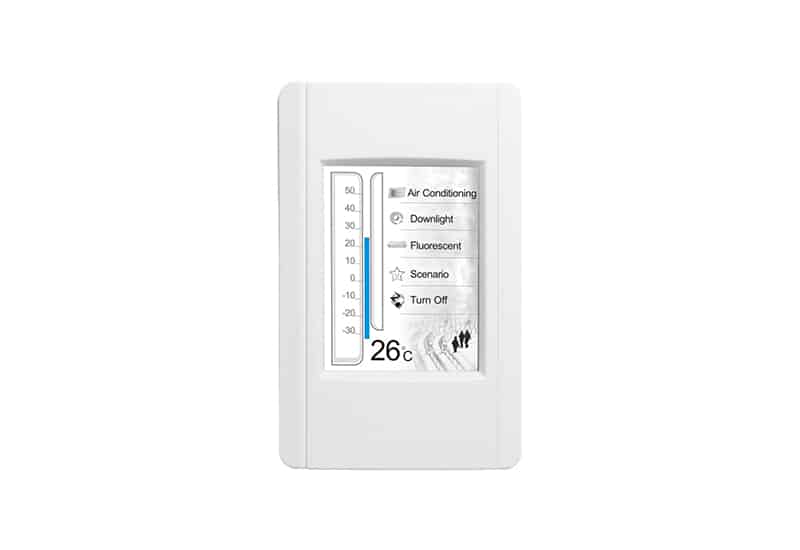
TPD-280/283 touch monitor HMI 2.8”, ICP DAS
Compact 2.8” touch monitor HMI for building and automation solutions, designed for wall mounting in standard boxes.
Advantages:
- 2.8” TFT color touchscreen
- PoE or 12-48 VDC power supply
- RS-485 and Ethernet
- Supports Modbus TCP/RTU
- Operating temperature: -20 to +70 °C
- Item no.: 51192
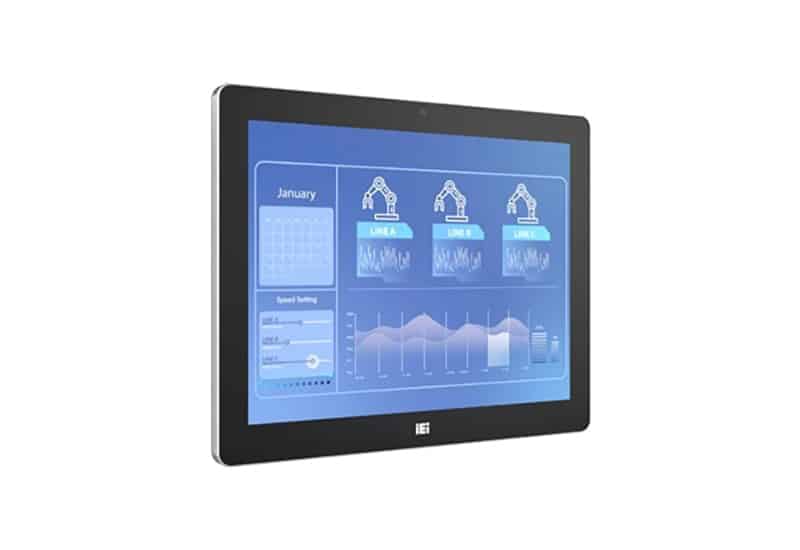
DM2-150E industrial touch monitor, IEI
The DM2-150E is an industrial 15” touchmonitor with IP65 front, built-in camera and front-mounted speakers.
Advantages:
- 15” PCAP touch, anti-glare/anti-UV
- HDMI, VGA and DisplayPort
- IP65 aluminum front panel
- Built-in camera and speakers
- 9-36 VDC power supply
- Item no.: 55384
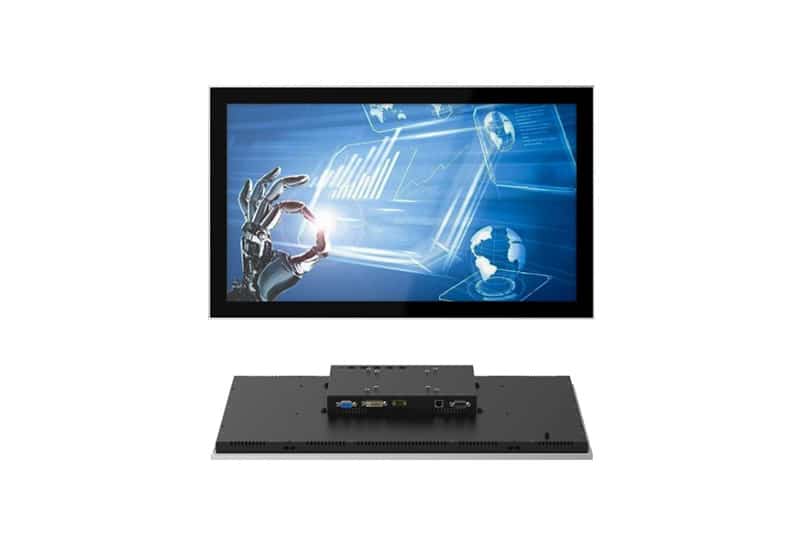
TM-PC215 21.5” industrial touchmonitor, Taicenn
The TM-PC215 is a robust 21.5” industrial touchmonitor with PCAP touch and IP65 front, suitable for panel and VESA mounting in industrial environments.
Advantages:
- 21.5” Full HD (1920×1080) TFT LCD
- Projected capacitive touch, up to 10 touch points
- 1 x VGA + 1 x DVI input
- Front IP65 protection
- 12 VDC (option 9-36 VDC)
- Item no.: 53586